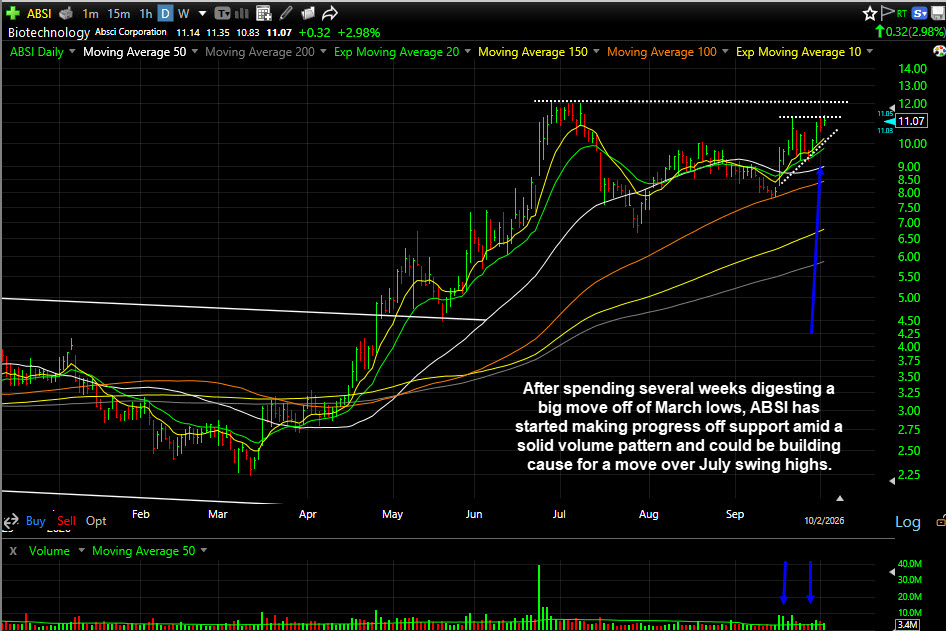
Our Stock of the Week is Absci Corporation (ABSI). Absci uses artificial intelligence to design antibody drugs, and its lead drug, ABS-201, is an injection for common hair loss that may need to be given only two or three times over six months. The first results on whether it grows hair in people are due this quarter, and the stock has been climbing steadily into that event.
For some context, the standard hair loss treatments are a daily foam or a daily pill, and many men quit the pill because of side effects. A shot a few times a year that regrows hair could address that issue. Early data has been encouragning, with the drug activating hair follicle stem cells in human scalp tissue within days, producing full regrowth in monkeys over six months, and proving safe in people so far, with no serious adverse events in the 32-participant Phase 1 data reported in June and an estimated half-life of at least 65 days.
Notably, endometriosis may be the bigger opportunity for ABS-201. The disease affects about 9 million women in the U.S. and causes chronic pain, and Absci says the hormone prolactin fuels lesion growth and makes pain nerves more sensitive, so blocking it could address both problems at once. Current treatments suppress estrogen, which limits how long women can stay on them. Management sees peak sales above $4.5 billion in endometriosis, which is a best case, and the mid-stage trial starting this quarter won’t report until the second half of 2027.
With a market cap of about $1.7 billion and roughly $200 million of that in cash, investors are valuing the pipeline at about $1.5 billion, roughly a third of what management sees as the peak sales potential for endometriosis alone, which means the program seems to be getting little credit at today’s price. Eli Lilly (LLY) was among the investors in the $100 million offering this summer, and the cash lasts into 2028, so there is no pressure to sell stock at a bad time.
Technically, after a decent run off lows in late 2023 and early 2024, ABSI spent the following two years in a steady descending channel before breaking past descending resistance in April. The stock saw strong upside follow-through over the next couple of months before digesting those gains beginning in July, and shares have since been flagging after turning lower from near-term resistance and could be building cause for a possible test of clear lateral resistance at $12. This is a catalyst trade, which means the stock tends to move in anticipation of the data and is at risk of a sell-the-news reaction even on good data, so we’d plan to manage a position accordingly.
As always, we’d avoid chasing any early strength on Monday morning, and would look to trade this name incrementally as the chart develops.