Our Stock of the Week is Hewlett Packard Enterprise (HPE). HPE has transformed itself from a slow-growth legacy hardware company into a major player in enterprise data center and computing infrastructure, positioning itself as an “edge-to-cloud hybrid infrastructure” provider (meaning that it sells the computing, storage, and networking equipment that businesses use to run their operations locally, in the cloud, or some mix of both) with growing exposure to AI server demand, hybrid cloud, and networking. That transformation has been driven by the 2025 acquisition of Juniper Networks, a networking equipment company known for the routers, switches, and AI-driven software, placing HPE in the middle of AI infrastructure buildout.
The pivot showed up in the numbers on June 1st, when HPE reported a blowout fiscal Q2 2026, which showed that revenue jumped 40% year-over-year to $10.7 billion (vs. est. $9.79 billion), with adjusted earnings of $0.79 per share (vs. est. $0.53), with server revenue alone coming in at $5.45 billion against expectations of $4.66 billion. The AI story has kept building since, with HPE unveiling its ProLiant Compute DL394 Gen12 server (built on Nvidia’s Vera CPU for AI workloads) and landing a marquee deal with Vultr, alongside Nvidia, to build large-scale AI data centers.
While the sector in general continued to see inflated multiples, HPE’s valuation still looks reasonable. Analysts are projecting 54% EPS growth over the next twelve months, and at a trailing PE of 19x and a forward PE of 12x, the stock carries a forward price-to-earnings growth ratio of just 0.2 (a reading below 1.0 is generally considered undervalued), suggesting the market has not fully priced in the earnings acceleration now underway. The average analyst price target, meanwhile, is $70.
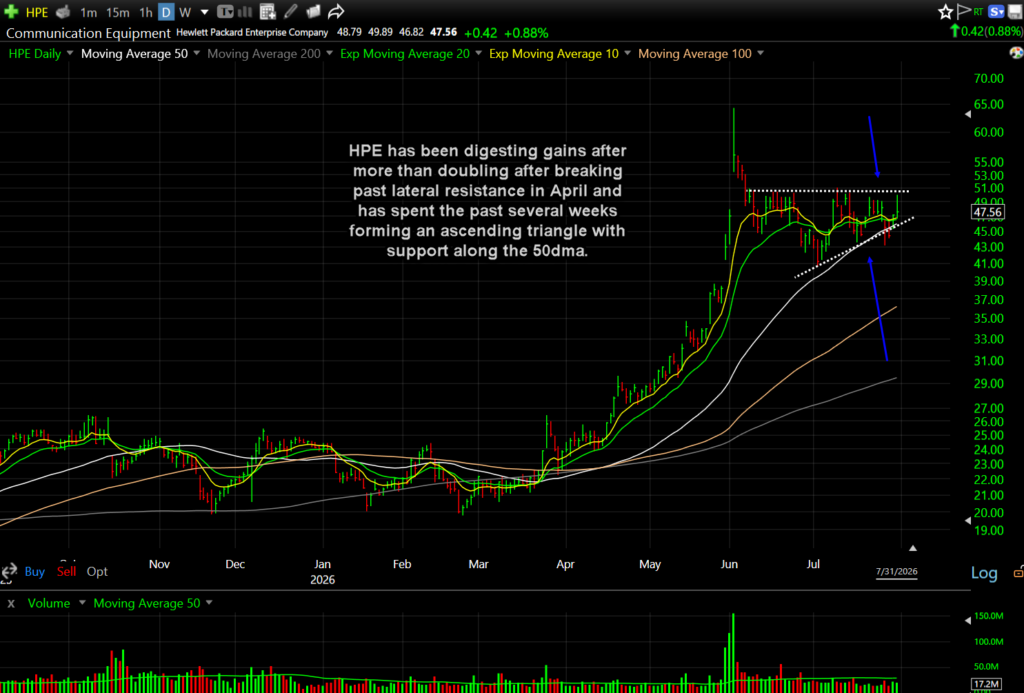
Technically, HPE broke past long-term resistance in April gaining ground amid the parabolic move in AI names in May before accelerating higher ahead of and following the June 1 earnings news. Shares pulled back immediately after, and since then, have spent the past couple of months forming an ascending triangle under near-term lateral resistance at $50, with support along its rising 50-day moving average. A move back over $50 could attract attention, and while we’d avoid chasing any early strength on Monday morning, we would look to aggressively trade the stock as the chart develops.