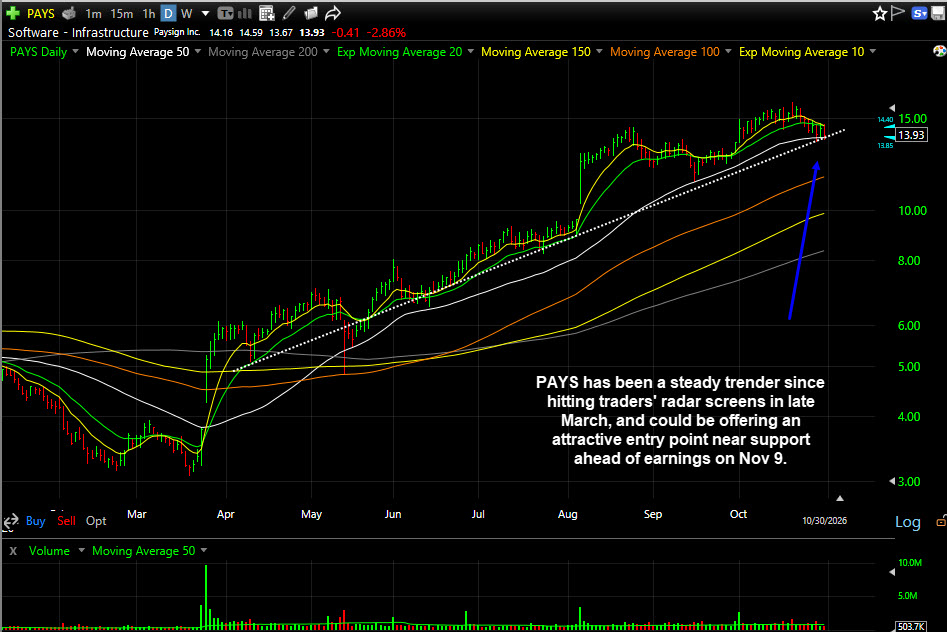
Our Stock of the Week is Paysign (PAYS). Paysign operates in two segments, one which offers prepaid debit cards that plasma donation centers use to pay donors, and another that administers copay assistance programs that drug companies use to cover a patient’s share of the cost of expensive medications. PAYS has more than quadrupled in value over the past 7 months due to strength in the copay assistance segment, and after pulling back to its 50-day moving average last week, could be offering an attractive entry point ahead of earnings on Monday, November 9.
For some context, the debit card business is the company’s cash cow, as PAYS loads roughly 45% of the plasma donor payments in the country onto its cards and collects fees each time a card is used. The copay business, meanwhile, is the growth engine. When a drug company offers a coupon that covers a patient’s copay on a specialty drug, insurers and pharmacy benefit managers have found ways to keep that money without applying it to the patient’s deductible (tactics known as accumulators and maximizers), and Paysign’s platform administers coupon programs designed to blunt them. Pharma revenue grew 89% in the June quarter, and now makes up more than half of total revenue. It also carries better margins than plasma, so the growth in the pharma segment is lifting profitability faster than sales.
Notably, the June quarter was the second in a row to come in above the top of the company’s own guidance, with earnings of $0.11 per share (vs. est. $0.06) on revenue of $28.3 million (vs. est. $26.4 million), with management raising its full-year revenue outlook to $114-$117 million from $106.5-$110.5 million. Adjusted operating margin rose to 21% from about 7.5% a year earlier, and the company has $27 million of cash and no debt. Importantly, management has guided its active copay programs, which stood at 148 at the end of June and 157 by the August call, to 165-170 by the end of September. Program adds are heaviest in the fourth quarter, so Monday’s report should show whether the September count landed in that range and what management says about fourth-quarter launches. The 2027 outlook doesn’t come until March, and that will likely decide whether the stock keeps working.
Technically, the stock peaked towards the end of October and has spent the past couple of weeks digesting gains, finding support at its 50dma. Since the report comes Monday after the close, we’d look to start a position near the 50-day and size it so that a bad reaction would mean a manageable loss. After the report, the plan depends on the program count. If the company hits 165 or better and talks up fourth-quarter launches, we’d add on a move back through $15, and if the count comes in light or the fourth-quarter outlook is soft, we’d take a stop and move on.
Interested in learning about how we help clients build long-term wealth and not end up being a charity to the IRS in the process? Click here to invest with RevShark, and let’s explore the how we can to make a significant impact on your results.
This post is for educational purposes only! This is not advice or a recommendation. We do not give investment advice. Do not act on this post. Do not buy, sell, or trade the stocks mentioned herein. We WILL actively trade this stock differently than discussed herein. We will sell into strength and buy or sell at any time for any reason. We will actively trade into any unusual activity. At the time of this post, principals, employees, and affiliates of Shark Investing, Inc. and/or principals, clients, employees, and affiliates of Hammerhead Financial Strategies, LLC, directly or indirectly, controlled investment and/or trading accounts containing no positions in PAYS at the time this was published. To accommodate the objectives of these investing and/or trading accounts, the trading in these shares will be contrary to and/or inconsistent with the information contained in this posting.